
Trusting AI in Business Operations: What SMBs Need to Get Right – Part 4
Key Takeaway
Trustworthy AI in business operations requires more than accuracy. For small businesses, consistency, transparency, human control and intelligent exception handling are essential to building confidence in AI automation. Conversational AI can help users question decisions, verify information and remain in control without adding more administrative complexity.
Businesses don’t buy tools because they are powerful. They buy them because they trust them. For small and mid-sized businesses, this isn’t just a corporate philosophy – it’s a survival tactic. When you run an SMB, every operational tweak carries real friction. A single misstep can tank your cash flow, bruise your reputation, or alienate a long-term customer.
In Parts 1-3, we looked at how AI is rewriting the rules of automation – scrapping clunky interfaces and letting lean teams focus entirely on business outcomes rather than wrestling with software. But we still have to answer one question: Can you actually trust AI to do real business work?
Why Trust Is the Real Bottleneck
Most SMB owners I talk to aren’t questioning AI’s raw capability anymore. They’ve seen the demos and watched it instantly parse messy invoices, auto-reply to client emails, and sync workflows across different apps.
The hesitation isn’t about what AI can do; it’s about what happens when things go sideways. Business owners are quietly asking themselves a different set of questions:
- Will the decisions made align with changing business needs?
- What happens when a customer throws an edge case at the system?
- Is this tool going to accidentally leak confidential client data?
- Am I just trading a manual task for a massive administrative headache?
This isn’t a tech problem – it’s a risk management problem. Too many software vendors try to win over buyers by flashing “99% accuracy” metrics. But in the real world, accuracy is just table stakes. True operational trust requires predictability over time, visibility into how decisions are being made, and clear controls so a human can step in and override the system the moment an anomaly pops up.
Designing for the Real World
If an AI system is going to earn its keep in an SMB environment, it needs to play by a practical set of rules. First, it should work with the software you already use and trust, rather than demanding a total, expensive rip-and-replace of your tech stack. It needs to adapt to your existing operational habits, not force your team to learn an entirely new way of working. It also needs to provide transparency into the process so that users have confidence in outcomes.
Most importantly, the system needs to know its own limits. True automation isn’t about blindly processing every task; it’s about intelligent exception handling. A trusted AI partner should be designed to recognize when a file looks corrupted or a client request seems ambiguous, and to hand the baton back to a human instead of guessing and hallucinating an answer.
The Power of a Conversation
This is where conversation-first AI completely changes the dynamic. When you interact with AI through a natural chat interface, it suddenly mirrors the way your business already runs. Think about how you delegate tasks today: you ask a question, give a quick instruction, and get a confirmation back.
When software acts like a sharp executive assistant rather than an opaque, automated black box, it breaks down the psychological barrier to adoption. It gives your team the room to double-check a decision, correct a slight misunderstanding on the fly, and slowly build confidence through daily interaction.
See Conversational AI in Action – Try One Receipt
Experience how Mr. Bizzy Expense Bot works. Send a receipt through WhatsApp and see how AI extracts and organizes your expense information – without downloading an app.
Moving From Blind Automation to Real Confidence
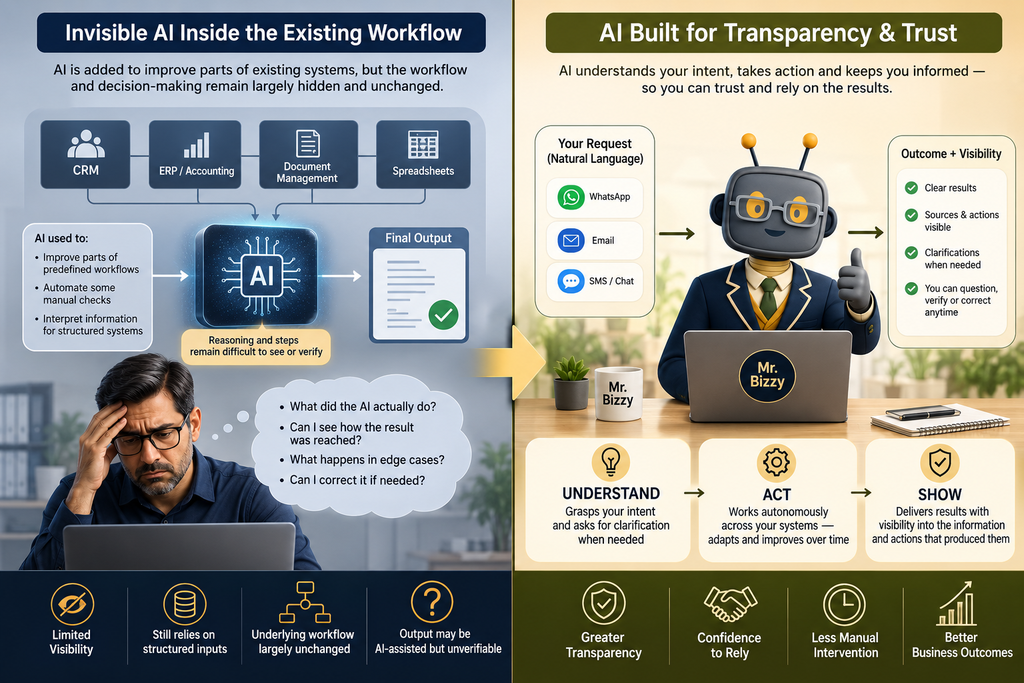
Traditional business software relies on rigid boundaries: strict guardrails, manual data entry, and highly structured inputs. Right now, a lot of “AI features” are just band-aids slapped onto these old architectures. The AI might clean up a data point or summarize a text block, but it passes that data right back into the same hidden pipeline. Because you can’t see the underlying logic, the final output still feels like a gamble.
We need to shift toward process transparency. Conversational AI, when designed for transparency, gives you the ability to audit the work mid-stream. If an output looks slightly off, you don’t have to wait until the end of the workflow and reverse-engineer the entire system to find the glitch. You can just ask the AI, “Why did you flag this invoice?” or “Clarify where you pulled this data point,” and verify the reasoning instantly.
Where This Leaves SMBs
AI is quickly evolving from a novelty feature into an invisible operational layer for small businesses. But its adoption won’t be driven by feature lists or tech specs; it will live or die based on user confidence.
When you implement AI with an eye toward visibility and control, it stops looking like an unpredictable experiment. It becomes something you can actually rely on – moving from a cool piece of tech to a genuine operational partner.
In Part 5, we’ll get tactical. We’re diving into real-world SMB case studies to look at exactly how conversational tools are changing the game for everyday expense tracking, client relationships, and document workflows.
Frequently Asked Questions About Trustworthy AI
Can small businesses trust AI with day-to-day operations?
Yes, AI can support day-to-day business operations when implemented with appropriate safeguards. Trustworthy AI systems should provide consistent performance, transparency into actions, human oversight and the ability to handle exceptions. Businesses should start with suitable processes and build confidence through repeated, verifiable results.
What makes AI automation trustworthy?
Trustworthy AI automation depends on more than accuracy. Important factors include consistency, reliability, transparency, data security, human control and intelligent exception handling. Businesses should be able to understand what actions were taken, verify relevant information and intervene when necessary.
How does conversational AI improve transparency?
Conversational AI can make business automation more transparent by allowing users to ask questions, request explanations, clarify instructions and verify outcomes through natural conversation. When the underlying system provides access to relevant data and action records, users can investigate decisions without navigating multiple applications or manually tracing an entire workflow.
Should AI replace existing business software?
Not necessarily. AI can work alongside existing accounting, CRM, document management and other business systems. This approach allows small businesses to automate administrative tasks while continuing to use familiar software and established processes.
See How Mr. Bizzy Simplifies Business Administration
Mr. Bizzy helps small businesses reduce repetitive administrative work through conversation-first AI. Send receipts, invoices and instructions through WhatsApp or email, while Bizzy handles the processing and organization behind the scenes.