
When work happens through conversation, automation becomes invisible – teams can focus on clients, decisions, and growth, not systems.
By Azfar Mahmood, CEO & Founder, Mr. Bizzy
In Part 1, we explored how AI transforms end-to-end automation by introducing an intelligence layer.
In Part 2, we looked at how removing apps and interfaces completes that shift through a conversation-first model.
For most small and mid-sized businesses, the promise of automation has never really been about technology.
It’s been about time.
- Time to focus on clients instead of getting lost in CRM screens
- Time to make decisions instead of managing tools that facilitate decisions
- Time to grow the business instead of staying busy with technology to run operations
For years, automation delivered mixed results. Systems were connected, but people still spent their days navigating dashboards, reconciling data, and translating real-world work into system-friendly formats.
AI changes that not by adding more intelligence to screens, but by removing the need to think about systems at all.
The Real Measure of Automation Isn’t Efficiency – It’s Focus
Traditional automation is measured in:
- Faster workflows
- Reduced errors
- Lower processing costs
Those metrics matter but they’re not what business owners feel day to day.
What they feel is:
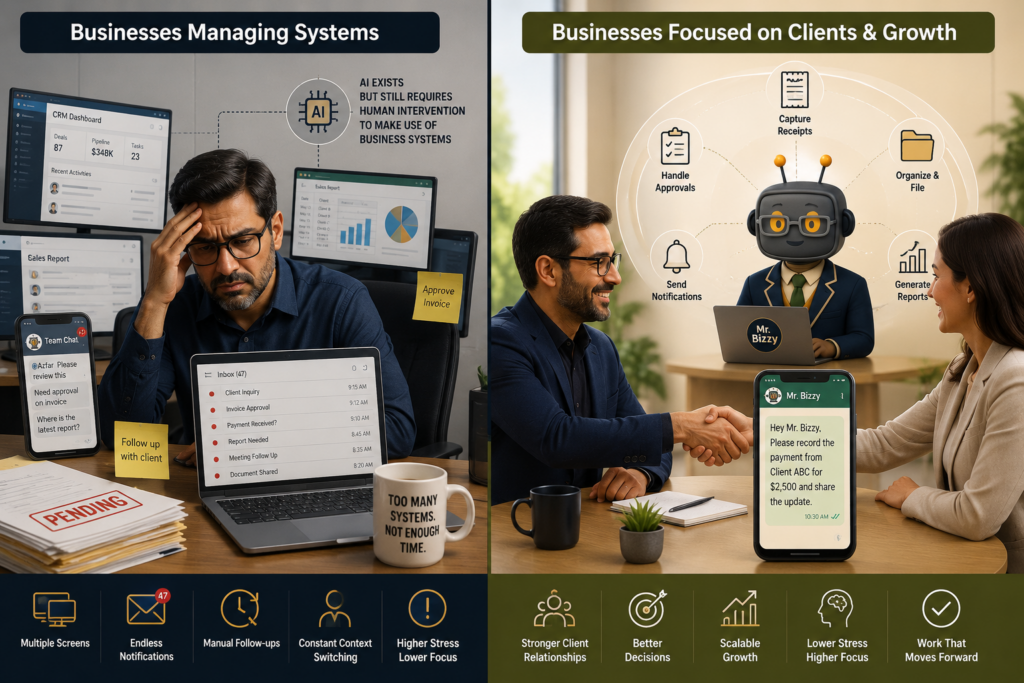
- Fewer distractions from real work because of complex systems
- Fewer app screens to follow up with clients
- Fewer tools demanding attention during business operations
True progress happens when automation fades into the background and work simply moves forward.
That’s the shift AI enables when it’s designed to operate quietly behind the scenes.
When AI Handles the Work, People Return to People
As AI takes over the interpretation, routing, and execution of operational tasks, something subtle but powerful happens inside organizations.
People stop acting as:
- Translators between emails and systems
- Verifiers of routine transactions
- Coordinators tracking approvals and handoffs
And start acting as:
- Advisors to clients
- Decision-makers
- Relationship builders
This isn’t about replacing human judgment. It’s about intelligently augmenting it, by removing the noise that prevents people from using it well.
Outcomes SMBs Actually Care About
When AI quietly manages the operational layer, SMBs see outcomes that go beyond efficiency:
- Better client experiences
Teams respond faster and more accurately because they’re not buried in administrative work. - Clearer decision-making
Information is available through simple questions, not reports and dashboards. - Healthier growth
Businesses scale without adding proportional operational overhead. - Lower cognitive load
Fewer systems to manage means fewer mistakes, fewer delays, and less burnout.
These benefits don’t come from better interfaces. They come from not needing interfaces and app screens at all.
The End Goal: Invisible Automation
The most successful technology platforms don’t demand attention. They earn trust by working reliably in the background.
In this model:
- Work arrives naturally—via messages, documents, or conversations
- AI understands intent and context
- Actions happen automatically across existing systems
- Humans stay informed without being involved in every step
This is what frictionless automation looks like in practice.
- Not louder tools.
- Not more dashboards.
- Just work getting done.
Where This Leaves SMBs
The future of business operations isn’t about teaching people new systems. It’s about letting them forget systems altogether.
When AI absorbs the operational complexity behind the scenes, businesses gain something far more valuable than automation:
Operational Clarity. Business Focus. Growth.
That’s the outcome SMBs have been working toward all along.
In Part 4, we’ll address a critical question for SMBs: If AI can handle operational work end-to-end, can it be trusted with business-critical processes? We’ll explore how trust, control, and reliability shape real-world AI adoption.
Bizzy Blog
Thoughts on AI, automation, and the future of SMB operations.