
AI can read receipts, understand emails, and execute workflows. So why are we still clicking through apps?
By Azfar Mahmood, CEO & Founder, Mr. Bizzy
In Part 1, we explored how AI fundamentally changes end-to-end automation by introducing an intelligence layer that understands information, builds context, and acts across systems. This shift removes many of the rigid rules and brittle workflows that limit traditional automation.
But even with AI in place, many businesses still face a familiar problem: people are required to adapt to software.
- Dashboards must be learned
- Interfaces must be navigated
- Inputs must be structured to match system expectations
To fully realize the promise of AI-driven automation, there is one more step: removing the traditional user interface – the app itself.
The Hidden Friction That Still Slows Automation
Most modern business tools, even AI-powered ones still rely on interfaces. They assume users will:
- Open an app or portal
- Learn where to click
- Translate real-world requests into system-friendly actions
- Switch between tools to complete a single task
This creates a subtle but persistent bottleneck. While AI may be doing more work behind the scenes, humans are still acting as operators, bridging the gap between intent and execution.
True end-to-end automation requires eliminating this gap altogether.
Conversation as the New Interface
A conversation-first AI model reverses the relationship between people and systems.
Instead of people learning software, software learns people.
In this model, users simply communicate the way they already do:
- Sending an email
- Texting via SMS or WhatsApp
- Asking a question in natural language
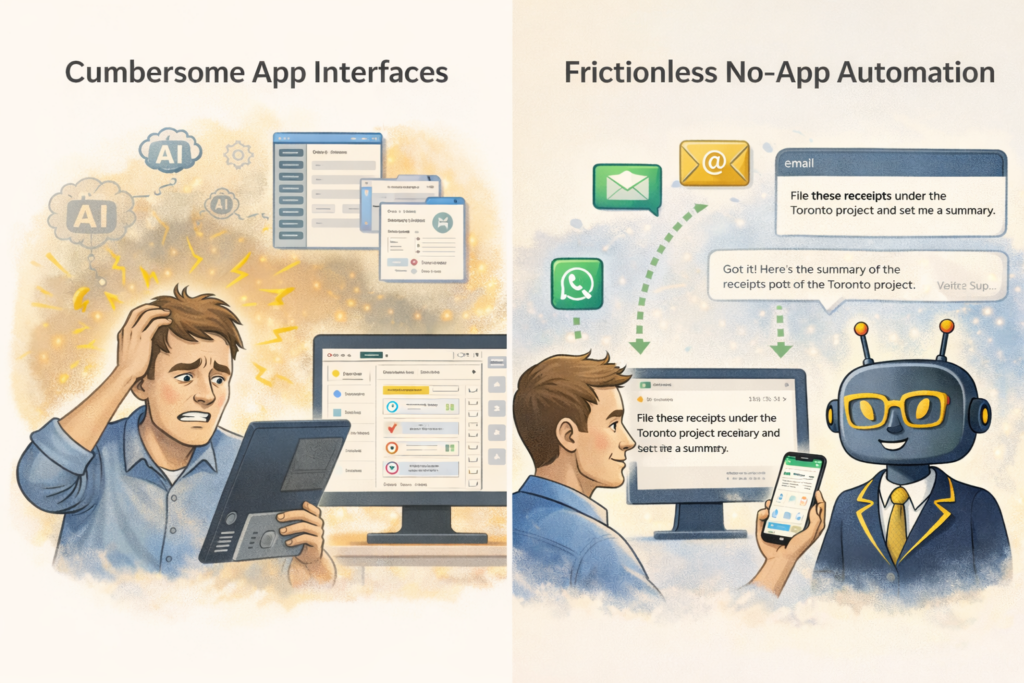
The AI interprets intent, applies context, and takes action across connected systems without exposing dashboards, workflows, or configuration screens to the user.
The traditional, complex, time-consuming user interface disappears. The outcome remains.
Why No-App Matters in AI-Driven Automation
Removing apps isn’t about convenience, it’s about completion.
When AI becomes the primary interface:
- There is no friction between intent and execution
- No translation layer between humans and systems
- No training curve for new workflows
- No switching between tools
- No dependency on structured inputs
AI becomes the operational middle layer – listening, interpreting, acting, and verifying.
A request like:
“File these receipts under the Toronto project and send me a summary.”
Or:
“What were our marketing expenses in January?”
No longer requires navigation, reports, or filters. The AI handles interpretation, data retrieval, categorization, and response – end to end.
Completing the End-to-End Automation Loop
When AI understanding (Part 1) is combined with a no-app, conversation-first model, something important happens:
Automation stops feeling like software – it feels like delegation.
The AI becomes a digital assistant embedded directly into daily communication, quietly absorbing administrative work while people stay focused on decisions, revenue, and relationships.
This is where end-to-end automation finally becomes real, not as a system design concept, but as a lived business experience.Platforms like Mr. Bizzy are built around this idea: AI that doesn’t ask users to adapt but adapts to how work already happens – through conversation, context, and action.
In Part 3, we move beyond interfaces entirely. What happens when AI handles the operational work so well that teams stop thinking about systems at all? That’s where automation turns into operational clarity, business focus, and growth.
Bizzy Blog
Thoughts on AI, automation, and the future of SMB operations